Speed of Reaction
Rate of reaction: define change per unit time, choose a measurable quantity, calculate rates with units and interpret reaction graphs.
On this page
Imagine collecting gas during a reaction. Measuring 20 cm³ tells you how much gas has collected; you also need the time interval to say how quickly it formed. Reaction rate connects the change with the time taken.
1. Definition
A. Speed (Rate) of Reaction
The speed of reaction (rate of reaction) is the change in amount of reactant used up or product formed per unit time.
B. Reactants and Products
- Reactants: starting substances used up in a reaction.
- Products: new substances formed in a reaction.
2. Key Ideas
- In a simple reaction proceeding forwards, reactants are used up and products form. Measure a change that tracks this reaction.
- Rate is always “change per time”, so it must have units (e.g., cm³/s, g/min, mol dm⁻³/s).
- You can find rate by measuring an observable change (mass, gas volume, colour, pH, precipitate, etc.).
- A reaction can be fast but produce very little product if the amount of reactant is small. Do not confuse rate with amount.
| Representation | What it tells you |
|---|---|
| Macroscopic | an observable quantity changes, such as gas volume increasing or mass decreasing |
| Particle | reactant particles are converted into product particles during effective collisions |
| Symbolic | rate is expressed as a change divided by a time interval, with a unit such as cm³ s⁻¹ |
Rate of reaction = amount of reactant used up or product formed per unit time.
3. Detailed Explanations
A. What “Per Unit Time” Means
An average rate describes a specified interval. Subtract the initial reading from the final reading and divide by the elapsed time. If the quantity decreases, such as mass when a gas escapes, use the positive amount lost.
Choose a quantity that tracks the reaction:
| What changes? | What you actually measure | Typical unit |
|---|---|---|
| Gas produced | volume of gas | cm³ s⁻¹ |
| Gas escapes | mass decreases | g min⁻¹ |
| Solution concentration | concentration changes | mol dm⁻³ s⁻¹ |
| Fixed visible change | time to reach the same end-point | compare reciprocal times, 1/t, in s⁻¹ |
Timing a fixed change lets you compare rates when the same change is reached in each experiment. The time has units of seconds; 1/t is a relative-rate measure in s⁻¹. Gas volume divided by time, such as cm³ s⁻¹, measures how much gas forms per second.
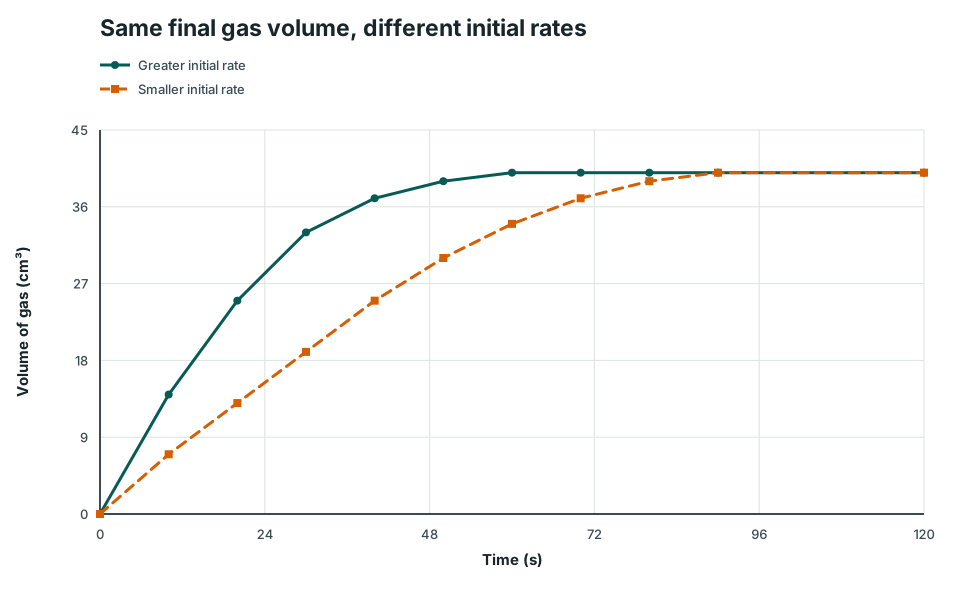
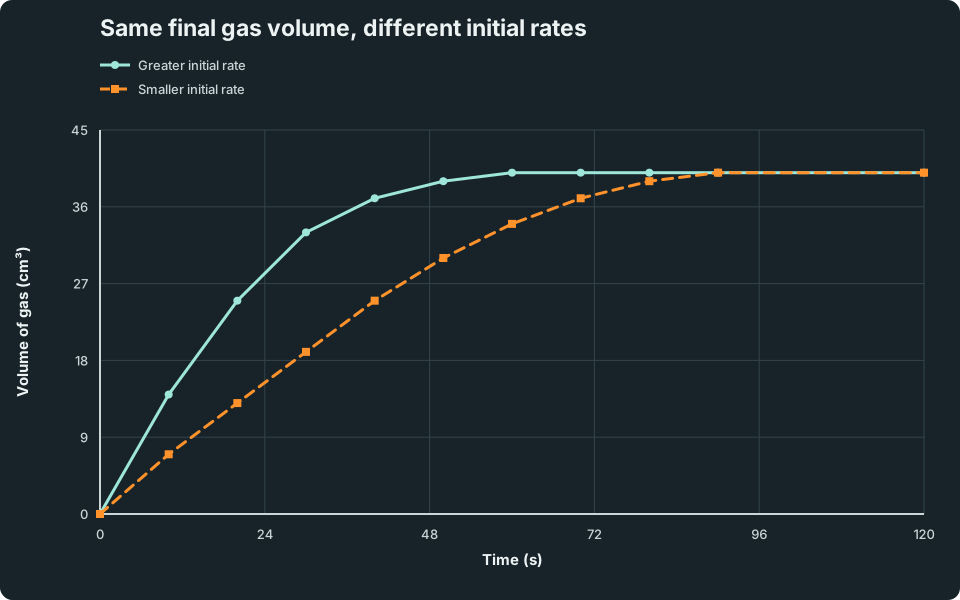
Same final gas volume, different initial rates
Gas volume against time for two illustrative reactions. Solid circles label the greater initial rate; dashed squares label the smaller initial rate. Both reach a horizontal plateau at 40 cubic centimetres.
Scroll across the graph to read all labels.
View figure data
| Time (s) | Greater initial rate | Smaller initial rate |
|---|---|---|
| 0 | 0 | 0 |
| 10 | 14 | 7 |
| 20 | 25 | 13 |
| 30 | 33 | 19 |
| 40 | 37 | 25 |
| 50 | 39 | 30 |
| 60 | 40 | 34 |
| 70 | 40 | 37 |
| 80 | 40 | 39 |
| 90 | 40 | 40 |
| 120 | 40 | 40 |
The illustrative graph compares reactions with the same final gas volume. Over the first 10 s, the solid curve rises by 14 cm³ and the dashed curve by 7 cm³. Their average rates over that interval are 14/10 = 1.4 and 7/10 = 0.70 cm³ s⁻¹. Both eventually reach 40 cm³. A faster start has not increased the final amount.
B. Try this next
Next, choose a practical measurement method in Measuring Reaction Rate. For gradients and tangents, use Reading Reaction-Rate Graphs. The particle explanations follow in:
4. Common Mistakes
- Writing “rate is how fast a reaction happens” without stating the measurable change per unit time.
- Giving only a time or amount when a rate is required. Include both the measurable change and “per unit time”.
- Confusing rate with time taken: shorter time usually means faster rate, but you must state the condition (same amount of reactant/product).
- Measuring the wrong thing (e.g., measuring “volume of air” instead of gas produced).
- Not stating units.
5. Exam Tips
Rate must have “per time” units. If your answer has no time unit, it is wrong.
- If given data in a table, rate is often “change in volume/mass/concentration ÷ time”.
- If asked for a method, write what you measure (e.g., “measure volume of gas every 10 s using a gas syringe”).
- For a fixed end-point comparison, use the same measurable change. When testing a factor, change that factor and control the other relevant conditions.
6. Worked Examples
Modelled example 1
Calculate an Average Rate (Gas Volume)
Problem
Study the worked solution
Identify the measurable change
Method
Use the 48 cm³ increase in gas volume.Reason
Average rate compares the amount of product formed with the elapsed time.Working
Change = 48 cm³; time = 60 s.Divide change by time
Method
Calculate volume formed per second.Reason
“Per unit time” means divide the measured change by the time interval.Working
rate = 48/60 = 0.80 cm³ s⁻¹.Report the rate
Method
Include the volume-per-time unit and two significant figures.Reason
The unit states what changed and the time basis; 0.80 matches the two significant figures in 48.Working
0.80 cm³ s⁻¹.
Guided practice 2
Calculate an Average Rate (Mass Loss)
Problem
Complete the change-per-time calculation
Hints
Hint 1: definition
Hint 2: unit
View solution step by step
Divide mass loss by time
Method
Divide 1.6 g by 4.0 min.Reason
The escaping gas causes a measurable mass decrease per unit time.Working
rate = 1.6/4.0 = 0.40.Attach the rate unit
Method
Report grams per minute.Reason
The numerator is mass change and the denominator is time in minutes.Working
0.40 g min⁻¹.
Common misconception 3
Spot the Bad Definition
Learner definition
Separate rate from completion time
View solution step by step
Identify the vague quantity
Method
Reject “how quickly” without a measurable change.Reason
A reaction can finish sooner because less reactant was present, even if its rate was not higher.Working
Completion time alone mixes rate with amount.Give the measurable definition
Method
State change in reactant or product per unit time.Reason
This identifies both what changes and the time denominator.Working
Rate of reaction is the amount of reactant used up or product formed per unit time.
Guided practice 4
Choose a Suitable Observable Change
Method transfer
Connect reaction evidence to a rate
Hints
Hint 1: read the equation
View solution step by step
Choose a product-linked observable
Method
Measure hydrogen volume as it forms.Reason
Hydrogen is a gaseous product, so its increasing volume tracks product formation.Working
Collect H₂ with a gas syringe at regular times.Define the rate quantity
Method
Calculate hydrogen volume formed per unit time.Reason
The unit must identify both the measured change and the time basis.Working
For example, rate in cm³ s⁻¹.
7. Mind Stretchers
Mind stretcher 1: Same Total Gas, Different RateExtension
Two experiments both produce 60 cm³ of gas in total. Experiment A reaches 60 cm³ in 30 s, Experiment B reaches 60 cm³ in 90 s. Which has the higher average rate? Explain.
Show Answer
Experiment A. For the same change (60 cm³), it takes less time, so rate is higher: 60/30 = 2.0 cm³/s vs 60/90 = 0.67 cm³/s.
Mind stretcher 2: “Fast” Does Not Mean “More”Extension
At 20 s, experiment X has collected 8 cm³ of gas; at 50 s it has collected 26 cm³. Experiment Y collects 12 cm³ over the same 30 s interval. Calculate and compare the average rates. X eventually produces 30 cm³ and Y 80 cm³: does Y’s greater final volume show that it had the faster rate over this interval?
Show Answer
For X, the interval change is 26 - 8 = 18 cm³, so the average rate is 18/30 = 0.60 cm³ s⁻¹. For Y, it is 12/30 = 0.40 cm³ s⁻¹. X has the greater rate over this interval. Y’s greater final gas volume describes the total amount, not the rate during the interval.
Practise and check
Use the Rate of Reactions topic check to practise definitions, units and measurement choices.
Open the topic checkSyllabus and review details
- SEC G3 Pure Chemistry 2027 · 2027
Content structure and subject content, PDF pages 9–24
Last reviewed: