Maxwell–Boltzmann energy distributions at two temperatures
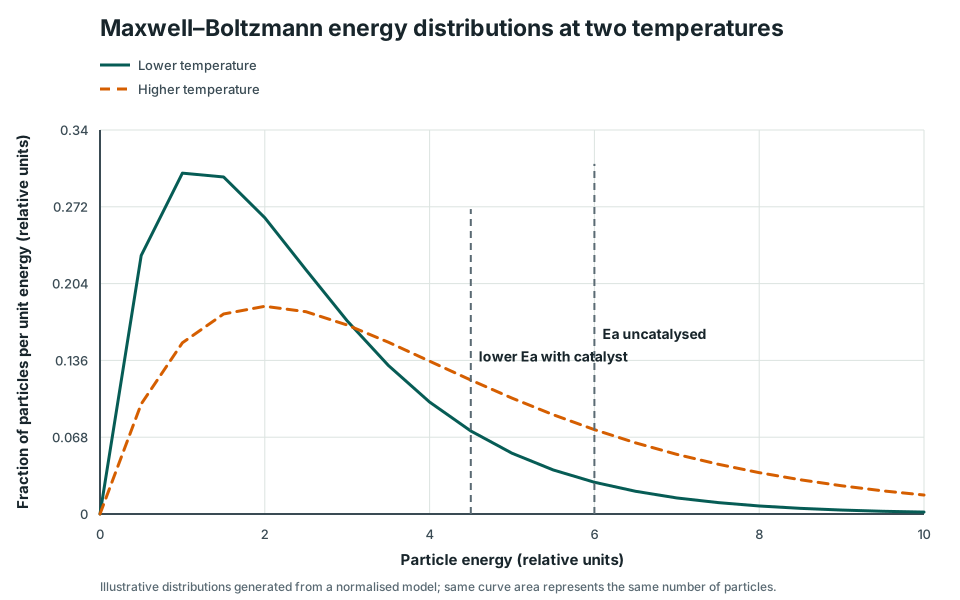
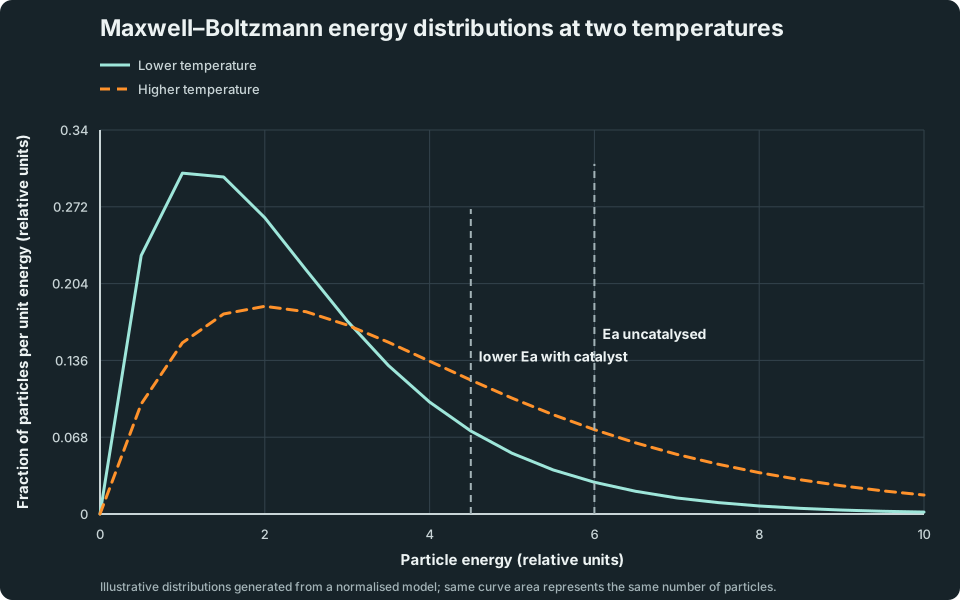
A lower-temperature curve has a taller peak at lower energy. A higher-temperature curve is lower and broader. Uncatalysed and catalysed activation-energy thresholds mark the fractions energetic enough to react.
Scroll across the graph to read all labels.
Kinetics bridge: temperature changes the energy distribution; a catalyst lowers Ea. Both increase the fraction able to react, but neither lets you infer the rate equation from the balanced equation.Open full-size graphView figure data
Values for Maxwell–Boltzmann energy distributions at two temperatures
Particle energy (relative units)
Lower temperature
Higher temperature
0
0
0
0.5
0.2289
0.0974
1
0.3018
0.1516
1.5
0.2984
0.1771
2
0.2623
0.1839
2.5
0.2162
0.1791
3
0.171
0.1673
3.5
0.1315
0.1521
4
0.0991
0.1353
4.5
0.0735
0.1186
5
0.0538
0.1026
5.5
0.039
0.0879
6
0.0281
0.0747
6.5
0.0201
0.063
7
0.0142
0.0528
7.5
0.0101
0.0441
8
0.0071
0.0366
8.5
0.005
0.0303
9
0.0035
0.025
9.5
0.0024
0.0205
10
0.0017
0.0168
Values for Maxwell–Boltzmann energy distributions at two temperatures
Particle energy (relative units)
Lower temperature
Higher temperature
0
0
0
0.5
0.2289
0.0974
1
0.3018
0.1516
1.5
0.2984
0.1771
2
0.2623
0.1839
2.5
0.2162
0.1791
3
0.171
0.1673
3.5
0.1315
0.1521
4
0.0991
0.1353
4.5
0.0735
0.1186
5
0.0538
0.1026
5.5
0.039
0.0879
6
0.0281
0.0747
6.5
0.0201
0.063
7
0.0142
0.0528
7.5
0.0101
0.0441
8
0.0071
0.0366
8.5
0.005
0.0303
9
0.0035
0.025
9.5
0.0024
0.0205
10
0.0017
0.0168
Quick Reference
If the question asks…
Start with…
What to show
“find the order” (initial rates)
compare experiments where only one concentration changes
show ratios, then state the order clearly
“write the rate equation”
use your orders
Rate = k[A]^m[B]ⁿ (define k)
“find units of k”
write rate units and concentration units
divide by concentration powers (use overall order)
“is it first order?”
compare successive halving intervals on concentration–time data
“constant half-life” wording
“link rate law to mechanism”
identify the rate-determining step
use the stated fast equilibrium where needed to remove an intermediate
What You Must Memorise
Rate equation form: rate = k[A]^m[B]ⁿ (orders are found experimentally).
Order meaning: doubling [A] changes rate by 2^m; zero order means no rate change when concentration changes.
Initial rates ratio (when only [A] changes): rate₂/rate₁ = ([A]₂/[A]₁)^m.
First-order signature required here: constant half-life from concentration–time data.
Boundary: integrated rate equations, logarithmic plots, the Arrhenius equation and steady-state derivations are not required by 9476.
Units anchor: rate typically in mol dm⁻³ s⁻¹; units of k depend on overall order.
Catalyst language: alternative pathway with lower Eₐ → larger fraction with E ≥ Eₐ.
Hub Quiz and Check Your Understanding
Use the quiz without notes first. Classify each error as rate-factor reasoning, graph evidence, mechanism consistency, collision theory, catalysis or enzyme conditions.
Work through questions with marking and feedback as you learn.
About 10 minutes
Time is up, but your answers have not been submitted yet. Check your connection and try again.
Questions are picked at random each time you start. You'll see the answer after each question. It's for practice only and doesn't count towards mastery.
Recent attempts
History is stored only in this browser.
No completed attempts are saved yet.
Beyond the syllabus: optional enrichment that does not count towards your progress.
After a check, practise the skills it showed you need to work on.
About 10 minutes
Time is up, but your answers have not been submitted yet. Check your connection and try again.
Questions are picked at random each time you start. You'll see the answer after each question. It's for practice only and doesn't count towards mastery.
Recent attempts
History is stored only in this browser.
No completed attempts are saved yet.
Beyond the syllabus: optional enrichment that does not count towards your progress.
Come back later to see whether your learning has lasted.
About 10 minutes
Time is up, but your answers have not been submitted yet. Check your connection and try again.
Answer 9 questions. You'll see your score, the answers and explanations at the end. A scheduled review counts towards your course progress only when it is due.
Recent attempts
History is stored only in this browser.
No completed attempts are saved yet.
Beyond the syllabus: optional enrichment that does not count towards your progress.