Alcohol Structures and Isomers
Draw and name C1–C4 alcohols, distinguish molecular and grouped formulae, and recognise changes in branching and hydroxyl-group position.
On this page
An oxygen atom in a formula does not automatically make a compound an alcohol. Find how the oxygen is bonded, then build structures by counting every atom and checking each atom’s bonds.
Recognise the alcohol group
The hydroxyl group
The alcohols studied here contain one hydroxyl group, -O-H, attached to a saturated carbon atom: that carbon has only single bonds. This is often written -OH.
Oxygen has two bonds, one to carbon and one to hydrogen. An OH within the -C(= O)OH group of a carboxylic acid belongs to a different functional group; it does not make that acid an alcohol.
A group is not an ion
The -OH group is covalently bonded within an alcohol molecule. It is not a separate hydroxide ion, OH⁻. Dissolving ethanol in water does not release hydroxide ions as an alkali does, so ethanol is not an alkali.
Count the hydrogen on oxygen too
For open-chain, saturated alcohols with one OH group, the grouped general formula is CₙH₂ₙ₊₁OH. The hydrogen in OH is additional to the 2n + 1 hydrogens written before it. The corresponding molecular formula is CₙH₂ₙ₊₂O.
For ethanol, n = 2: C₂H₅OH contains two C, six H and one O, so its molecular formula is C₂H₆O. A molecular formula gives totals; it does not prove that an OH group is present or show where it is attached.
Draw and compare C1–C4 structures
The unbranched series
Build the unbranched alcohols
Each molecule contains one oxygen bonded to a carbon and a hydrogen. Methanol has one carbon, ethanol two, and propan-1-ol three in an unbranched chain.
Scroll across the graph to read all labels.
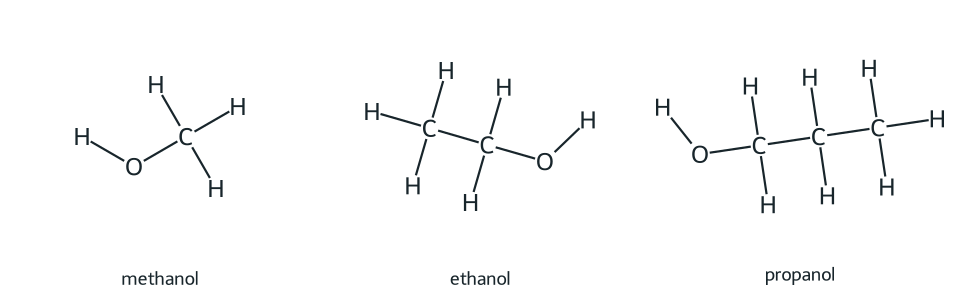
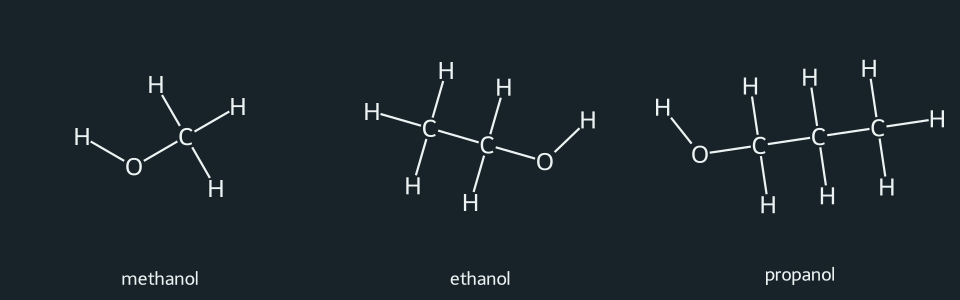
View figure data
| Alcohol | Molecular formula | Carbon atoms | Position of -OH |
|---|---|---|---|
| methanol | CH4O | 1 | on the carbon |
| ethanol | C2H6O | 2 | on an end carbon |
| propanol | C3H8O | 3 | on an end carbon |
| Name | Molecular formula | Grouped formula | Condensed structural formula |
|---|---|---|---|
| Methanol | CH₄O | CH₃OH | CH₃-OH |
| Ethanol | C₂H₆O | C₂H₅OH | CH₃-CH₂-OH |
| Propan-1-ol (propanol) | C₃H₈O | C₃H₇OH | CH₃-CH₂-CH₂-OH |
| Butan-1-ol (butanol) | C₄H₁₀O | C₄H₉OH | CH₃-CH₂-CH₂-CH₂-OH |
The names methanol to butanol identify the unbranched series. A position number distinguishes structures when the OH group can be attached at different places. The table gives the structures with OH on an end carbon.
Change branching or OH position
Keep four carbons while changing the skeleton
Butan-1-ol has a continuous four-carbon chain. The branched structure has a central CH attached to two CH3 groups and a CH2OH group. Both contain four carbons, ten hydrogens and one oxygen.
Scroll across the graph to read all labels.
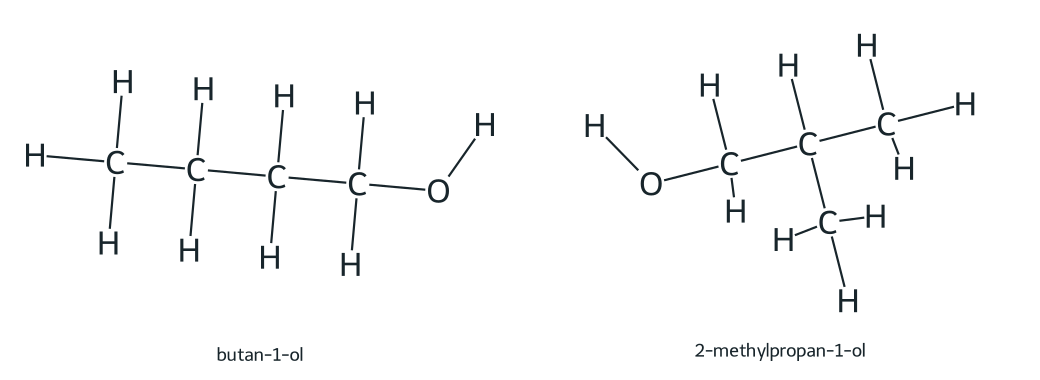
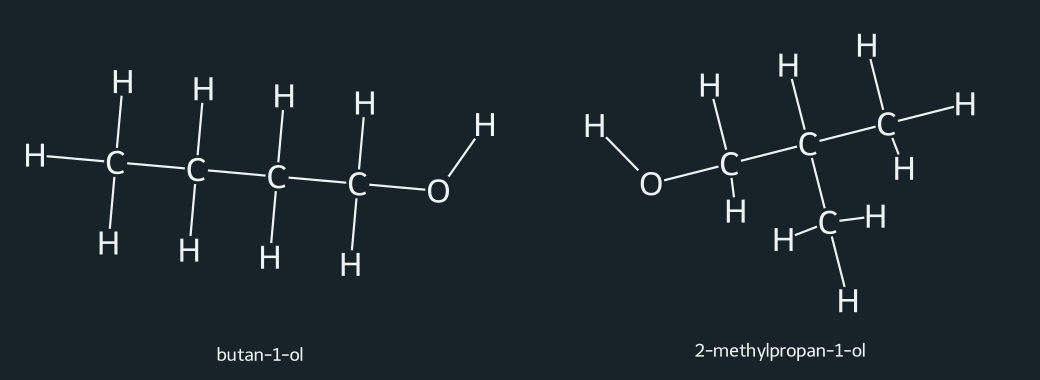
View figure data
| Alcohol | Molecular formula | Condensed structural formula | Carbon skeleton |
|---|---|---|---|
| butan-1-ol | C4H10O | CH3CH2CH2CH2OH | Unbranched |
| 2-methylpropan-1-ol | C4H10O | (CH3)2CHCH2OH | Branched |
The OH group need not be on an end carbon. These condensed structural formulae show other valid alcohols; the supplied names help you distinguish them:
| Name | Condensed structural formula | Change from the end-OH unbranched structure |
|---|---|---|
| Propan-2-ol | CH₃-CH(OH)-CH₃ | OH is on the middle carbon. |
| Butan-2-ol | CH₃-CH(OH)-CH₂-CH₃ | OH is on carbon 2. |
| 2-Methylpropan-1-ol | (CH₃)₂CH-CH₂-OH | Carbon skeleton is branched. |
| 2-Methylpropan-2-ol | (CH₃)₃C-OH | Three CH3 groups and OH attach to the central carbon. |
Parentheses collect attached groups rather than extending the main chain. In CH₃-CH(OH)-CH₃, OH attaches to the middle carbon; in (CH₃)₃C-OH, three CH3 groups attach to the central carbon.
Changing OH position or branching can give structural isomers: the molecular formula remains the same, but atom connections differ. Rotating a drawing or reading the same chain from the other end does not create a new structure.
Build a drawing in four steps
- Draw the carbon skeleton, including each branch.
- Attach O–H to the chosen carbon with a single C–O bond.
- Add hydrogens until each carbon has four bonds. Oxygen already has two.
- Count every atom, including H on oxygen, and compare with the molecular formula.
Making ethanol
Ethanol Production compares the two production routes.
Fermentation
Find the glucose-to-ethanol equation and conditions.
Hydration
Find the ethene-and-steam equation and conditions.
Ethanol as a fuel
Combustion requires counting the oxygen already in ethanol.
Oxidising ethanol
Oxidation changes ethanol into ethanoic acid. Use that specific example rather than assuming every alcohol structure forms an acid in the same way.
Check the bonds and atom totals
- The OH hydrogen counts towards the total; C₄H₉OH contains ten H, not nine.
- A branch carbon still counts towards n.
- An OH group uses one of its attached carbon’s four bonds.
- The formula CₙH₂ₙ₊₂O alone does not identify an alcohol: check for a C–O–H connection.
Make the structure visible
A molecular formula cannot replace a requested structural drawing. Show the bonds needed to locate OH and any branches. If asked for a displayed formula, show every atom and bond, including O–H.
Draw and check two structures
Examiner practice 1
Draw unbranched and branched alcohols
Examination question
Draw and check both structures
View solution step by step
Draw an unbranched structure
2 marksMethod
Use a continuous four-carbon chain and attach one -OH group.Reason
The structure must contain four carbon atoms and one hydroxyl group.Working
CH₃-CH₂-CH₂-CH₂-OH.Draw a branched structure
2 marksMethod
Use a three-carbon chain with a one-carbon branch and attach one -OH group.Reason
This changes the carbon skeleton without changing the molecular formula.Working
(CH₃)₂CH-CH₂-OH.
Self-mark with the mark scheme
Compare your response with each mark point. Select a point only when your response contains that evidence.
Self-mark the carbon skeleton, hydroxyl group and atom count in each structure.
Explain oxygen exclusion
The fermentation example is beside the production explanation.
Compare production routes
The factory-choice example is with the route comparison.
Count oxygen in combustion
The combustion example is with the fuel equation.
Interpret an oxidation observation
The oxidation example is with the reagent and product.
Try without prompts
Mind stretcher 1: One formula, different functional groupsExtension
A is CH₃CH₂-O-CH₂CH₃, B is CH₃CH₂CH₂CH₂OH and C is (CH₃)₃COH. Count their atoms and identify which are alcohols. Are B and C structural isomers? Explain why the oxygen in A is not enough to classify it as an alcohol. You do not need to name A’s functional group.
Show answer
All three have molecular formula C₄H₁₀O. B and C contain C–O–H groups attached to saturated carbons and are alcohols. They are structural isomers: B is unbranched and C is branched. A’s oxygen bonds to two carbons and has no O–H bond, so A is not an alcohol. Molecular formulae give atom totals, not functional-group connectivity.
Mind stretcher 2: Is ethanol an alkali?Extension
A learner says: “Ethanol is an alkali because it contains OH.” Explain what is wrong.
Show answer
Ethanol has a covalently bonded OH group within a molecule, not separate hydroxide ions. It does not release OH⁻ into water as an alkali does.
Explain a failed fermentation
Try the fermentation-temperature question.
Practise and check
Use the Organic Chemistry topic check to practise and check your understanding.
Syllabus and review details
- SEC G3 Pure Chemistry 2027 · 2027
Content structure and subject content, PDF pages 9–24
Last reviewed: