Alkene Structures and the Bromine Test
Draw C2–C4 alkene structures, distinguish structural isomers, and use bromine-water observations to identify unsaturation.
On this page
An alkene’s double bond affects both its structure and its reactions. Start by locating the double bond and counting atoms, then use a chemical test to compare an alkene with an alkane.
Find the carbon–carbon double bond
The alkene series
The alkenes studied here are open-chain hydrocarbons with one carbon–carbon double bond, C = C. Their general formula is CₙH₂ₙ. Each carbon still forms four bonds: a double bond counts as two.
Unsaturated and saturated
An unsaturated hydrocarbon has a carbon–carbon multiple bond. In these lessons, that is a C = C double bond. Alkenes are unsaturated; alkanes have no carbon–carbon multiple bonds and are saturated.
Why the double bond matters
Atoms can add across an alkene’s double bond. The carbon–carbon connection becomes a single bond, with a new bond formed at each carbon. See Addition Reactions of Alkenes for the products and conditions.
Use formulae as a check, not a drawing
For ethene, n = 2, so 2n = 4 and its molecular formula is C₂H₄. There is no one-carbon alkene: a carbon–carbon double bond needs two carbon atoms.
A molecular formula counts atoms. It does not show their connections, the position of a double bond, or whether the carbon skeleton forms a ring. Use the general formula to check a proposed open-chain alkene, then inspect its structural formula.
Build and compare structures
Ethene and propene
Count four bonds at each carbon
Ethene has two carbons joined by a double bond, each with two hydrogens. Propene adds a CH3 group to one of those carbons; that carbon then has one hydrogen.
Scroll across the graph to read all labels.
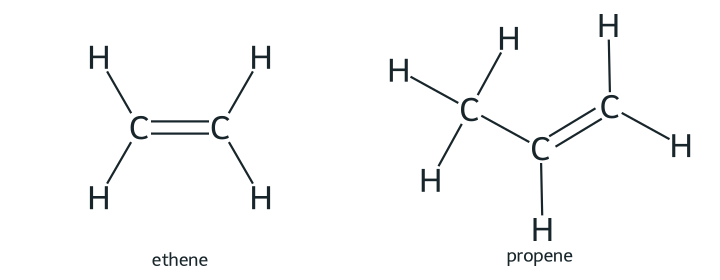
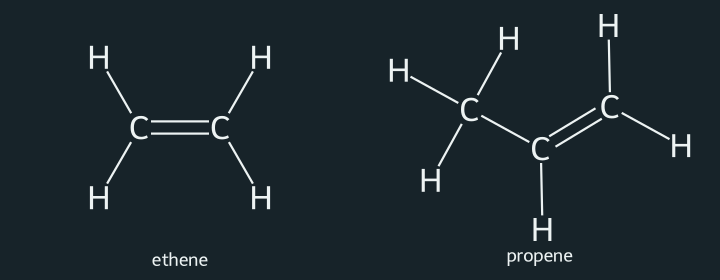
View figure data
| Alkene | Molecular formula | Carbon–carbon bonds | Hydrogen atoms |
|---|---|---|---|
| ethene | C2H4 | 1 double | 4 |
| propene | C3H6 | 1 double, 1 single | 6 |
| Name | Molecular formula | Condensed structural formula |
|---|---|---|
| Ethene | C₂H₄ | CH₂ = CH₂ |
| Propene | C₃H₆ | CH₂ = CH-CH₃ |
Change position or branching without changing atom totals
Three different carbon connections for C4H8
But-1-ene and but-2-ene have four-carbon unbranched skeletons with different double-bond positions. Methylpropene has a branched skeleton. Each contains four carbon and eight hydrogen atoms.
Scroll across the graph to read all labels.
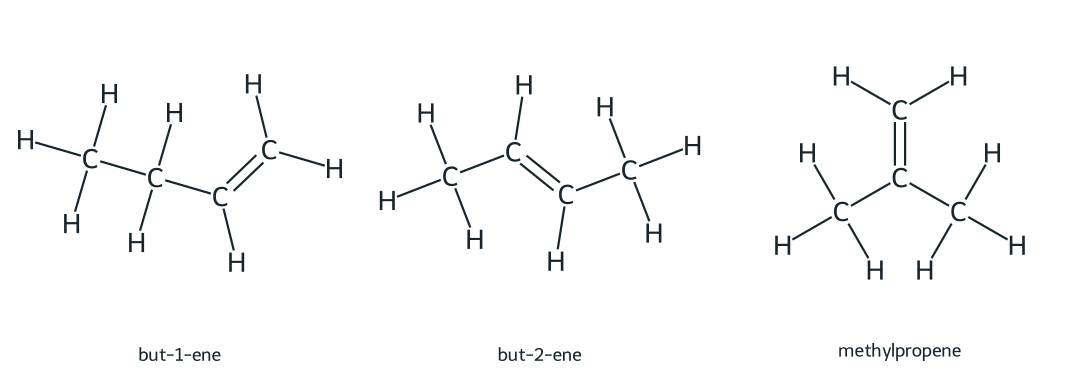
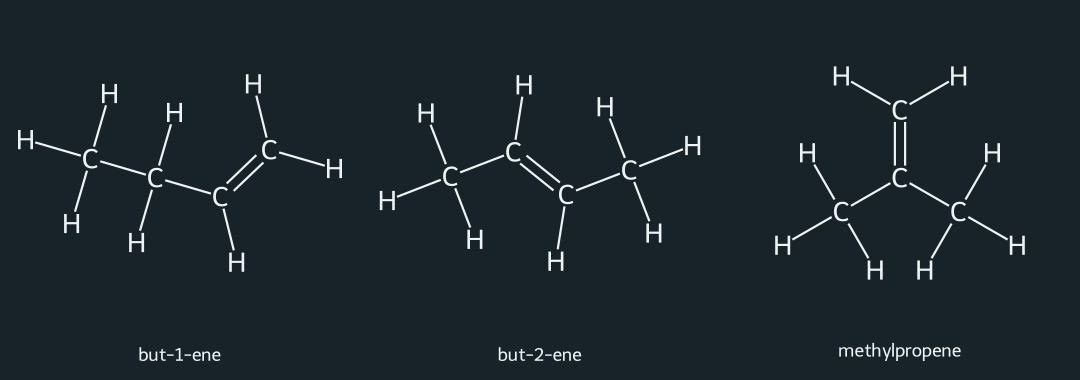
View figure data
| Structure | Molecular formula | Condensed structural formula | Carbon skeleton |
|---|---|---|---|
| but-1-ene | C4H8 | CH2=CHCH2CH3 | Unbranched; end double bond |
| but-2-ene | C4H8 | CH3CH=CHCH3 | Unbranched; internal double bond |
| methylpropene | C4H8 | CH2=C(CH3)2 | Branched |
| Structure | Condensed structural formula | What differs? |
|---|---|---|
| But-1-ene | CH₂ = CH-CH₂-CH₃ | Double bond starts at carbon 1. |
| But-2-ene | CH₃-CH = CH-CH₃ | Double bond starts at carbon 2. |
| Methylpropene (name supplied) | CH₂ = C(CH₃)₂ | Branched carbon skeleton. |
All three have molecular formula C₄H₈, but different atom connections, so they are structural isomers. In CH₂ = C(CH₃)₂, both bracketed CH₃ groups attach to the second carbon of the double bond.
Number an unbranched chain from the end nearer the double bond. Writing but-1-ene from the other end gives CH₃-CH₂-CH = CH₂, which is the same compound. It does not create a new isomer called “but-3-ene”.
Use bromine water: observation, then conclusion
In the usual test, away from UV light, an alkene reacts with aqueous bromine (bromine water) and removes its red-brown colour. An alkane does not decolourise it under these conditions.
| Sample | Observation | Conclusion for these hydrocarbon samples |
|---|---|---|
| Ethene | Red-brown bromine water becomes colourless. | Unsaturated: contains C = C. |
| Ethane | Bromine water remains red-brown. | Saturated: no C = C. |
“Colourless” describes the absence of colour. “Clear” describes transparency, so it does not tell you whether the bromine colour has disappeared. A colourless result identifies unsaturation in this comparison, not the exact alkene or its double-bond position.
Bromine water is hazardous. Follow the teacher’s risk assessment, use small quantities and wear eye protection. Describe the observed colour change separately from what you infer about the structure.
Where alkenes come from
Cracking and Refinery Demand explains how hydrocarbons are changed to make smaller molecules, including alkenes and sometimes hydrogen.
Burning ethene
Find the equation and product states in the combustion section.
Predicting addition products
The reaction lesson follows the same double bond through several changes:
Hydrogenation
Adding hydrogen converts ethene to ethane.
Hydration
Adding steam converts ethene to ethanol.
Addition polymerisation
Joining alkene monomers makes a long chain.
Vegetable oils and hydrogenation
The food application explains polyunsaturation and margarine manufacture.
Check bonds before naming
- Count a double bond as two bonds when adding hydrogen to a displayed structure.
- Include every branch carbon in the molecular formula.
- A reversed drawing has the same connectivity; it is not another structural isomer.
- A molecular formula alone does not prove where a double bond lies.
Make your reasoning visible
When asked to draw a structure, show the required bonds and atoms rather than only the molecular formula. When asked for a test, state the reagent, each sample’s observation and the conclusion supported by that observation.
Check a formula and plan a comparison
Modelled example 1
General formula check
Problem
Study the worked solution
Choose the alkene formula
Method
Use CₙH₂ₙ for an open-chain alkene with one double bond.Reason
The formula relates the hydrogen subscript to the number of carbon atoms.Working
For C₅H₁₀, n = 5.Substitute and compare
Method
Calculate the required number of hydrogen atoms.Reason
2n = 2(5) = 10, matching the given formula.Working
C₅H₁₀ fits CₙH₂ₙ, so it can be an alkene.
Guided practice 2
Bromine water test (distinguish alkane vs alkene)
Problem
Choose the reagent and observations
Hints
Hint 1: bond difference
Hint 2: observation wording
View solution step by step
Add the test reagent
Method
Add small amounts of red-brown bromine water to separate samples, away from UV light.Reason
Bromine undergoes addition across an alkene’s C = C bond.Working
Use equal small samples so their observations can be compared.Distinguish the samples
Method
Identify ethene by decolourisation and ethane by no change.Reason
Ethene is unsaturated; ethane has no double bond and does not react under normal conditions.Working
Ethene: red-brown → colourless. Ethane: remains red-brown.
Correct a repeating unit
The repeating-unit example is beside the polymerisation explanation.
Explain hydration conditions
The hydration example is beside the ethanol equation.
Deduce a cracking product
The atom-conservation example is beside the cracking model.
Try without prompts
Mind stretcher 1: What can the evidence distinguish?Extension
A is CH₂ = CHCH₂CH₃, B is CH₃CH = CHCH₃ and C is CH₃CH₂CH₂CH₃. Work out their molecular formulae. Identify a structural-isomer pair and predict each bromine-water observation away from UV light. Can this test distinguish A from B? Explain.
Show answer
A and B are both C₄H₈ and have different double-bond positions, so they are structural isomers. C is C₄H₁₀ and is not their isomer. A and B decolourise red-brown bromine water; C leaves it red-brown. The test cannot distinguish A from B because both contain C = C; it does not locate the double bond.
Mind stretcher 2: Check the direction of a colour changeExtension
A learner writes: “Alkenes turn bromine water from colourless to red-brown.” Explain the error and correct it.
Show answer
The direction is reversed. Bromine water starts red-brown and becomes colourless as the alkene reacts with it.
Compare cracking with separation
Try the cracking-versus-distillation question.
Practise and check
Use the Organic Chemistry topic check to practise and check your understanding.
Syllabus and review details
- SEC G3 Pure Chemistry 2027 · 2027
Content structure and subject content, PDF pages 9–24
Last reviewed: