Carboxylic Acid Structures and Reactions
Draw and name C1–C4 carboxylic acids, explain partial ionisation, and predict reactions with metals, bases and carbonates.
On this page
A carboxylic acid has a different functional group from an alcohol, yet it shares familiar acid reaction patterns. Read its structure first, then connect the group to ionisation and the products of a reaction.
Recognise the whole carboxyl group
One carbon and two oxygens in the group
A carboxylic acid contains the carboxyl group, -C(= O)OH. It is often written -COOH or -CO₂H. The same carbon is double-bonded to one oxygen and single-bonded to another oxygen, which bonds to hydrogen.
The C=O part is a carbonyl group. Read the carbonyl and OH together as COOH; the OH within this group does not make the compound an alcohol.
Acids can form esters
An ester has -C(= O)-O⁻ with an organic group attached after the single-bonded oxygen. Study its structure and name in Esters: Formation and Naming.
Esterification
A carboxylic acid can react reversibly with an alcohol to make an ester and water. The esterification explanation develops that reaction.
Count the carboxyl carbon
The C1–C4 acids in this series have unbranched carbon skeletons with one carboxyl group. The carbon inside COOH counts towards the total used in the name. Methanoic acid has one carbon; ethanoic acid has two, not one.
Build the series and use acid chemistry
C1–C4 structures
The carboxyl carbon counts
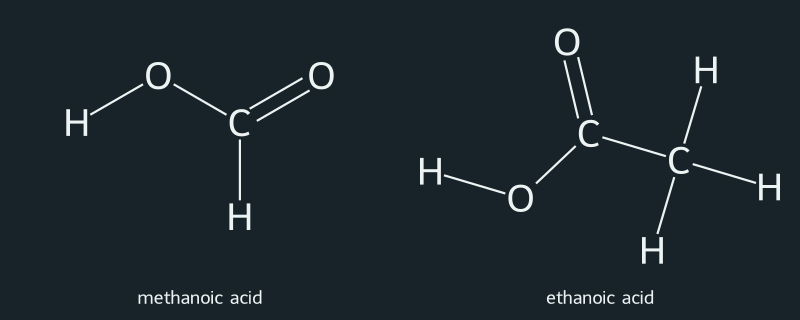
Methanoic acid has one carbon bonded to H, double-bonded to O and single-bonded to OH. Ethanoic acid has a CH3 group bonded to the carboxyl carbon instead of that H.
Scroll across the graph to read all labels.
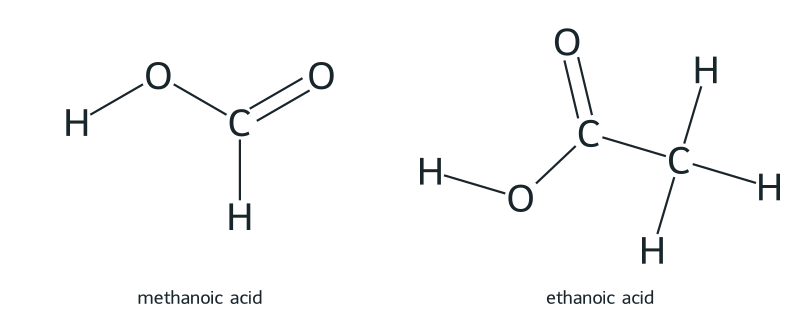
View figure data
| Carboxylic acid | Molecular formula | Condensed structural formula | Total carbons |
|---|---|---|---|
| methanoic acid | CH2O2 | HCOOH | 1 |
| ethanoic acid | C2H4O2 | CH3COOH | 2 |
Extend the chain, keep the same functional group
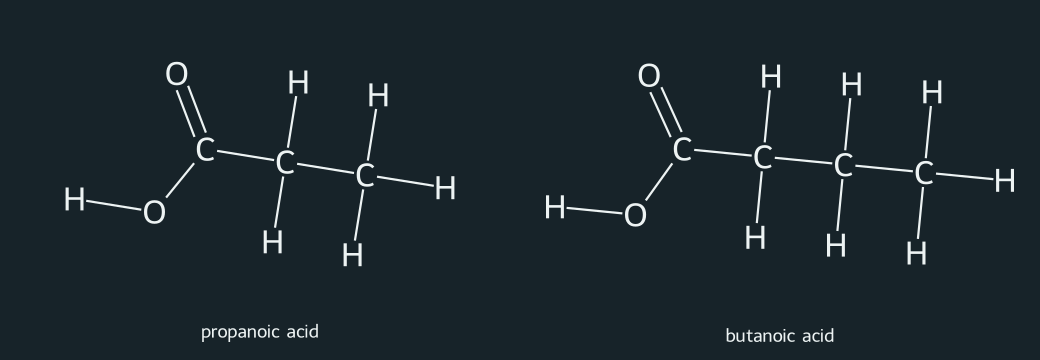
Propanoic acid has CH3–CH2 attached to the carboxyl carbon. Butanoic acid has CH3–CH2–CH2 attached to it. Including the carboxyl carbon gives three and four carbons respectively.
Scroll across the graph to read all labels.
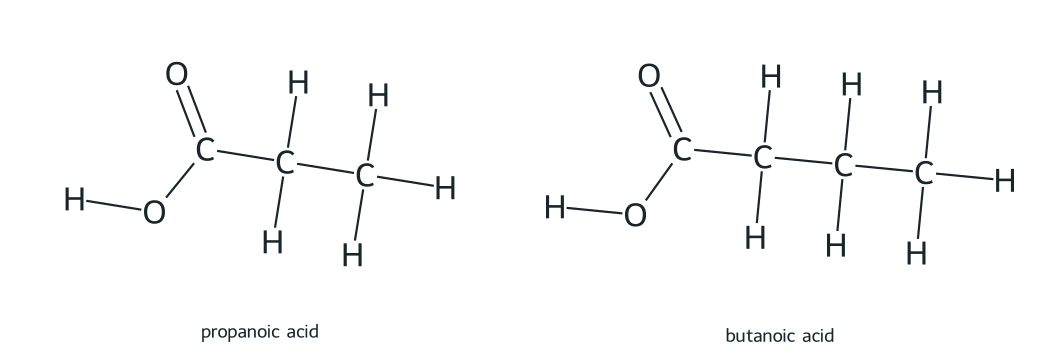
View figure data
| Carboxylic acid | Molecular formula | Condensed structural formula | Total carbons |
|---|---|---|---|
| propanoic acid | C3H6O2 | CH3CH2COOH | 3 |
| butanoic acid | C4H8O2 | CH3CH2CH2COOH | 4 |
| Name | Molecular formula | Condensed structural formula |
|---|---|---|
| Methanoic acid | CH₂O₂ | H-C(= O)-OH, or HCOOH |
| Ethanoic acid | C₂H₄O₂ | CH₃-C(= O)-OH, or CH₃COOH |
| Propanoic acid | C₃H₆O₂ | CH₃-CH₂-C(= O)-OH |
| Butanoic acid | C₄H₈O₂ | CH₃-CH₂-CH₂-C(= O)-OH |
A molecular formula gives atom totals. The condensed structural formula groups atoms to show the chain and COOH connection. Each successive member here adds CH2 while retaining the same functional group; they form a homologous series.
Weak does not mean dilute or unreactive
Carboxylic acids partially ionise in water. For ethanoic acid:
Weak describes incomplete ionisation. Dilute describes a low amount of acid per unit volume. An acid can be weak and concentrated, or strong and dilute; the words answer different questions.
Partial ionisation still produces hydrogen ions, so ethanoic acid can react with metals, bases and carbonates. As hydrogen ions are used up, more acid can ionise. Do not predict “no reaction” simply because the acid is weak. Review acidity and acid strength if you need this distinction.
Use the familiar product patterns
With a suitable reactive metal, such as magnesium: salt and hydrogen form.
The salt is magnesium ethanoate. Mg²⁺ needs two ethanoate ions, CH₃COO⁻. “Acid + metal” is not a rule that every metal must react readily; use a suitable metal such as magnesium in this example.
With a base: salt and water form. Bases include alkalis such as sodium hydroxide and insoluble metal oxides such as copper(II) oxide.
With a carbonate: salt, water and carbon dioxide form.
The salt name changes with the acid and cation, while the reaction pattern remains. Ethanoic acid makes ethanoates; propanoic acid makes propanoates. Use the acid reaction patterns to connect the gas or water product to the other reactant.
Form an ester
Esters: Formation and Naming gives the reversible equation and catalyst.
Name an ester
The two name parts come from the alcohol and acid respectively.
Read an ester structure in either direction
The structure-to-reactants method counts the carbonyl carbon with the acid-derived side.
Check the group and products
- Include the carbon in COOH when naming and counting atoms.
- COOH is a carboxyl group; it is not just an alcohol’s OH group.
- Weak acids still produce hydrogen ions and undergo acid reactions.
- Carbonates give carbon dioxide; a suitable metal gives hydrogen. Use the other reactant to choose the gas.
Connect words, ions and equations
Explain weak acidity using partial ionisation in water, rather than an unsupported claim about concentration. For a reaction, identify the other reactant, choose the product pattern, name the salt, and balance atoms and charges where relevant.
Explain weakness and balance a carbonate reaction
Modelled example 1
Identify weak acid behaviour
Problem
Study the worked solution
State the extent of ionisation
Method
State that ethanoic acid ionises only partially.Reason
Only some acid molecules form ions in water; “weak” does not mean dilute.Working
Acid molecules and ions coexist at equilibrium; ionisation is not complete.Represent the equilibrium
Method
Use a reversible arrow between molecules and ions.Reason
Ionisation and recombination occur in both directions.Working
CH₃COOH(aq) ⇌ CH₃COO⁻(aq) + H⁺(aq).
Guided practice 2
Acid + carbonate products
Problem
Apply the acid–carbonate pattern
Hints
Hint 1: reaction pattern
Hint 2: salt formula
View solution step by step
Name the products
Method
Form sodium ethanoate, water and carbon dioxide.Reason
The salt combines sodium ions from the carbonate with ethanoate ions from the acid.Working
CH₃COONa, H₂O and CO₂.Balance the equation
Method
Use two ethanoic acid and two sodium ethanoate units.Reason
This conserves both sodium ions and both ethanoate groups; the remaining atoms form water and carbon dioxide.Working
2CH₃COOH(aq) + Na₂CO₃(s) → 2CH₃COONa(aq) + H₂O(l) + CO₂(g).
Correct an ester name
The ester-name example is beside the naming explanation.
Build an ester from its reactants
The formula-building example is with the ester structures.
Recover the reactants from a name
The reverse-name example is with ester naming.
Try without prompts
Mind stretcher 1: Does weak acidity limit the final gas amount?Extension
Two samples each contain 0.010 mol of a monoprotic acid: one is hydrochloric acid and one is ethanoic acid. Each reacts separately with excess magnesium until all the acid has reacted. A learner predicts less hydrogen from ethanoic acid because it is weak. Is that prediction justified? Calculate the amount of hydrogen from each sample and distinguish final amount from reaction rate.
Show answer
Both produce 0.0050 mol H2: two moles of either monoprotic acid react to give one mole of hydrogen. Ethanoic acid’s partial ionisation does not prevent further ionisation as H+ is consumed. For equal concentrations and comparable conditions, a weak acid generally reacts more slowly initially because fewer hydrogen ions are present. The stated completed reactions still use the same number of acid moles and give the same final hydrogen amount.
Mind stretcher 2: Is the name one carbon too long?Extension
A learner labels CH₃CH₂CH₂COOH “pentanoic acid” because they count four carbons in the chain and then add the COOH carbon again. Correct the name and give the molecular formula. Explain how your count avoids including the same carbon twice.
Show answer
The name is butanoic acid, with four carbons in total: one in CH3, two in the CH2 groups and one in COOH. Its molecular formula is C4H8O2. The COOH carbon is already the fourth carbon, so adding it again would double-count it.
Check an ester name
Read an ester formula backwards
Try the ester-to-reactants question.
Practise and check
Use the Organic Chemistry topic check to practise and check your understanding.
Syllabus and review details
- SEC G3 Pure Chemistry 2027 · 2027
Content structure and subject content, PDF pages 9–24
Last reviewed: